Los Angeles
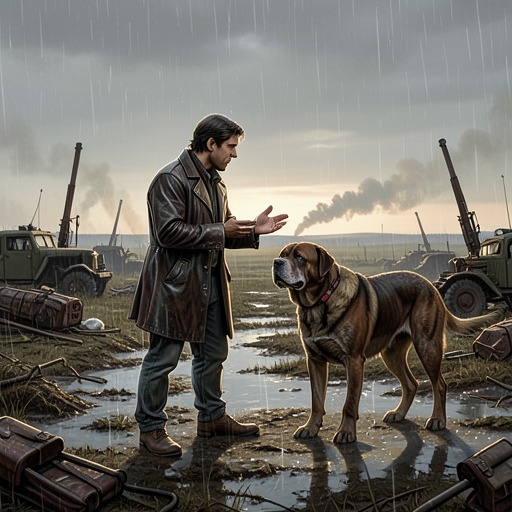
A Boy and His DogLos Angeles is the central geography of A Boy and His Dog: a war-scarred city where radioactive hills, bombed-out buildings, improvised roverpak territories, and the access route to the Downunder make survival inseparable from place. Its ruins are not empty. They are organized by competing services, defended by armed groups, crossed by predators and scavengers, and haunted by the technological history that transformed dogs into telepathic military partners. The city therefore functions both as setting and as a social diagram of collapse, revealing how different communities preserve power, pleasure, labor, or mere existence amid the aftermath of World War III.
A Ruined but Structured City
Los Angeles has survived the nuclear war in a state of radical physical damage. Vic and Blood move through bombed-out shells of buildings, while a bluish-green radiation still flickers from the surrounding hills. The landscape is dangerous enough to contain burnpit-screamers and other threats, yet it remains legible as a city because its surviving groups have claimed particular functions and territories. The devastation has not erased social organization; it has forced organization into harsher, more specialized forms.
The city’s roverpaks embody this adaptation. The Dragons maintain an entire power plant in order to collect tribute from other roverpaks. Ted’s Bunch watches over the reservoir. The Bastinados labor in marijuana gardens, and the Barbados Blacks lose members each year while cleaning radiation pits. These groups occupy different positions in a local economy whose resources are dangerous, indispensable, and unevenly distributed. Their work shows that Los Angeles is not simply a wasteland populated by isolated survivors. It is a fractured political landscape in which territory and service determine authority.
The Metropole Theater Enclave
The Our Gang roverpak has taken over the area around the Metropole Theater. Unlike groups that depend on foraging or hazardous public works, Our Gang has built its livelihood around maintaining access to films. Other survivors tolerate its control because everyone needs the movies, and because the group keeps the theater operating better than anyone else. The arrangement gives the theater a peculiar protected status: a cultural institution becomes an essential service, and entertainment becomes a reason not to challenge armed local authority.
The theater’s security makes this contradiction visible. Visitors must surrender their weapons at the entrance, where guards carry bren guns and a child with large leathery warts checks firearms beside the ticket booth. Vic pays admission with a can of Oscar Mayer Philadelphia Scrapple for himself and a tin of sardines for Blood. When leaking water threatens to rust his Browning and .45, he forces the checker to move them to a drier part of the rack, while the guards permit the confrontation rather than escalate it. The theater thus reproduces both the rituals of ordinary public life—tickets, concessions, rules, and shared entertainment—and the coercive conditions of the ruined city.
Its preservation is also an ironic measure of social priorities. The surrounding buildings remain unrepaired because Our Gang needs only the theater to earn its livelihood, whereas rival roverpaks must sustain power infrastructure, water, agriculture, or radiation-clearing operations. In Los Angeles, cultural continuity can survive beside architectural destruction, and a functioning movie house may command more dependable protection than a neighborhood.
The City as a Threshold to the Downunder
The outskirts of Los Angeles lead toward the Downunder through an access dropshaft. When Blood follows the scent of a girl toward the city’s edge, Vic recognizes that almost nothing else would draw someone into that bleak zone except screamers or the entrance to the underground civilization. The radioactive hills and the shaft mark a threshold between the exposed surface and the enclosed society below. Los Angeles is consequently more than a destination: it is the upper world from which the story approaches a radically different social order.
The city’s surface culture also establishes the values that the Downunder will challenge. Vic and Blood live as solos, relying on scavenging, pursuit, weapons, and their interdependent arrangement. Blood finds women for Vic, while Vic secures food for Blood. Their movement through Los Angeles is governed by immediate appetite and tactical knowledge, not by the formal restrictions of the underground community. The city’s open ruins allow mobility, but they also normalize violence and exploitation; the Downunder’s later rules acquire force partly because the surface has made brutality ordinary.
Scientific and Historical Los Angeles
Los Angeles is connected to the prewar history of animal telepathy. More than sixty-five years before the main action, in Los Angeles, a man named Buesing lived in Cerritos and raised dogs as watchmen, sentries, and attackers. His four-year-old German shepherd, Ginger, worked for the Los Angeles Police Department’s narcotics division and could detect marijuana hidden through layers of packaging. In a test involving 25,000 boxes in an auto-parts warehouse, five packages were concealed inside sealed cartons; Ginger found all five within seven minutes.
That history places the city at the beginning of the transformation that shaped the postwar world. In Santa Barbara, cetologists were simultaneously experimenting with amplified dolphin spinal fluid, injections into baboons and dogs, and surgical alteration and grafting. The first successful product was Ahbhu, a two-year-old male Puli capable of communicating sense-impressions telepathically. Later cross-breeding and experimentation produced the skirmisher dogs used in the Third War to track gasoline, troops, poison gas, and radiation while linked to human controllers. Ginger and Ahbhu became Blood’s ancestors, tying the ruined Los Angeles of the present to the scientific institutions, police work, and military research that preceded the war.
This connection makes the city a site of technological inheritance as well as destruction. The same region associated with police detection, animal training, and experimental communication also becomes the landscape through which a telepathic dog survives after civilization has broken apart. Los Angeles carries both the promise of scientific partnership and the consequences of turning animal intelligence into a military resource.
Memory, Animals, and the City’s Human Meaning
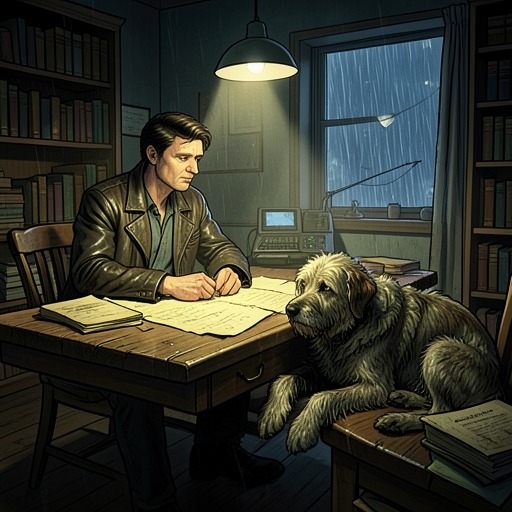
Los Angeles also has a personal significance beyond the novella’s fictional ruins. Harlan Ellison recalls meeting Ahbhu at the West Los Angeles Animal Shelter after wanting a dog because loneliness had made him remember the companionship of his childhood dog. The little Puli had just been brought to the shelter and was being attacked by three larger dogs in a cage when Ellison encountered him. That meeting became the foundation for the author’s relationship with Ahbhu and, indirectly, for Blood.
The city remains present in Ahbhu’s later life. Ellison describes the dog as an independent person rather than a pet, with his own personality and chosen circle of friends. Women who had had unsatisfactory affairs with Ellison nevertheless returned to visit Ahbhu, and one actress sent a driver to collect him for Sunday afternoons at the beach. The dog’s social world was therefore not merely an extension of the author’s; it belonged to Ahbhu himself. Ellison also recalls that Ahbhu, normally fearless enough to attack the Pacific Ocean and walk confidently among vicious cats, was terrified by a major Los Angeles earthquake and clung to Ellison by wrapping his forelegs around his neck.
The contrast between the fictional city’s radioactive ruins and the remembered city of shelters, beaches, earthquakes, and companionship gives Los Angeles a double identity. It is a damaged future landscape, but it is also the real urban setting from which the story’s animal-centered imagination emerged. The place links public catastrophe with private attachment: the city produces war technologies and ruined territories, yet it also contains the shelter where a dog becomes a friend, a collaborator, and the inspiration for a story whose deepest question is whether love can exist across the boundary between human and animal.